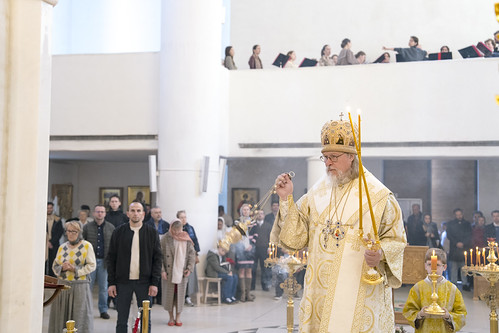
METROPOLITAN MARK CELEBRATED THE SUDAY LITURGY AT THE CATHEDRAL
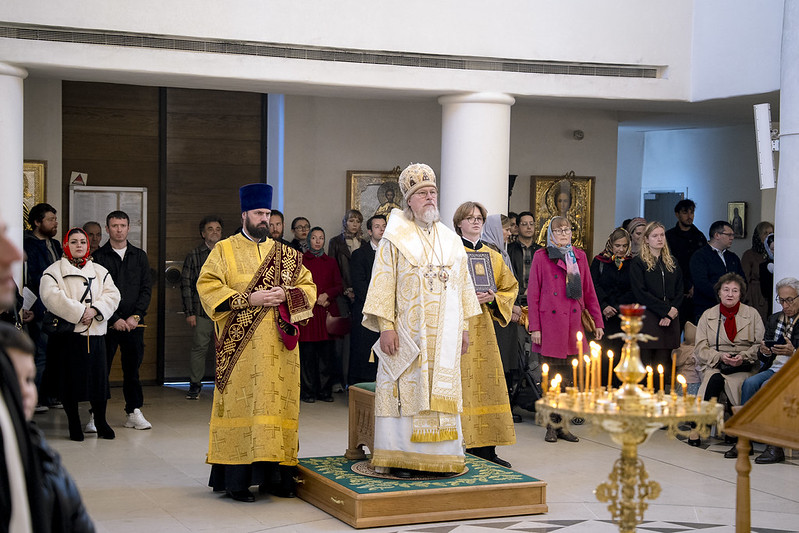
On 1 November 2026, the Twenty-Second Sunday after Pentecost, Metropolitan Mark of Korsun and Western Europe, Patriarchal Exarch of Western Europe, celebrated the Divine Liturgy at Holy Trinity Cathedral.
Concelebrating with His Eminence were Priest Maxim Politov, secretary of the Korsun Diocesan Administration, and the cathedral clergy.
The hymns and the liturgical exclamations were in Church Slavonic and in French.
After the Prayer Behind the Ambo, Metropolitan Mark addressed those taking part in the Liturgy with a homily:
In the name of the Father and of the Son and of the Holy Spirit!
When we read the Holy Gospel, dear brothers and sisters, we see that the words of our Saviour are unlike the manner of teaching used by today’s preachers, theologians and philosophers.
Christ always speaks very simply, and most often His teaching takes the form of parables and images. In today’s Sunday Gospel we heard another of the Saviour’s parables, the parable of the sower.
It is one of the rare cases in which the Saviour Himself afterwards, alone with His disciples, gave them the interpretation of His own words. Christ says that the result of this saving sowing, the result of His teaching about the Kingdom of Heaven, depends on how ready people’s hearts are to receive His words.
Christ tells us that God is always ready to reveal Himself to people, always ready to give us spiritual food. But it depends on you and me whether we accept this divine seed of the word of God or reject it outright, through our own passivity or through our enslavement to sinful passions.
Let us notice that, by ordinary human reckoning, it makes no sense to throw seed onto the road: where there is no soil, the seed is obviously bound to be eaten by the birds.
By the same practical reckoning there is no sense in sowing on stony ground either, for there is too little soil there, and as a rule the plants, even if they begin to grow, wither in time.
The same can be said of seed thrown among weeds, since weeds are usually hardier and stronger than cultivated plants. And so it is we ourselves who are responsible for how the word of God takes root in us.
We often think that everything is the fault of our surroundings, or we often say: ‘Well, we are not saints!’ Of course we are not saints, but how the word of God works in a person’s soul depends on that person.
In the lives of the saints there are a great many examples of how the word of God works in the souls of the righteous. We listen to the teaching of the Gospel again and again. We listen and are sometimes moved by it, but then we leave the church and forget those Gospel lessons. We imagine they are there to enrich our experience, so that we may know the Gospel story, understand how to settle this or that theological question, how to answer in this or that situation. But the main point is that we often stop seeing the Gospel as a book of life written for you and me.
We may recall how certain holy fathers, on hearing words from the Gospel or from an apostle, took them as a call to act, went out into the desert, renewed their lives, changed their whole course. These are the people the Saviour speaks of last of all in the parable. Those whose hearts proved to be good soil, ready to receive the word of God and to bear fruit.
Of course we often look for excuses. The priest is the wrong one, or something else is not as it should be. But we forget that the task of the Church is to bring the word of God to people. The task of the Church is, despite human weakness and imperfection, to tell people about the new reality the Lord brought to earth, about the Kingdom of Heaven, which for us is to begin here, in this world.
Let us keep this parable in mind, and every time we turn aside to evil deeds and thoughts, grow angry, commit sins, fall into the passions or take offence at others, let us remember that it is we ourselves who prove unable to receive the word of God purely and undamaged, and who therefore fail to bear the fruit we should.
The Church always speaks of the personal responsibility of each person for everything that happens in his life. Let us too, dear brothers and sisters, as we listen to the words of the Holy Gospel and weigh our own deeds, remember our responsibility for all that we do in our lives. Amen.